Fireflies 2026: where I found them and how I photographed them
Ladislav Petruš · 2026
For a long time I'd been trying to find a firefly population worth photographing around Bratislava. In previous years I only ever saw a handful of flying individuals, which fit the hypothesis that they're gradually retreating, even dying out. But it turns out I simply wasn't in the right place at the right time - large populations are still relatively easy to find. You just have to know where and when to look for them.
This year I managed to find - and properly photograph - three populations: the first, very numerous, in the floodplain forests between Rusovce and Čunovo; the second, even more numerous, in the Little Carpathians above Smolenice; and the third, also very numerous, likewise in the Little Carpathians above Bratislava - in the Vydrica area, where there is no night lighting. What's more, these weren't isolated pockets; in all three the whole surrounding forest was glowing to some degree.
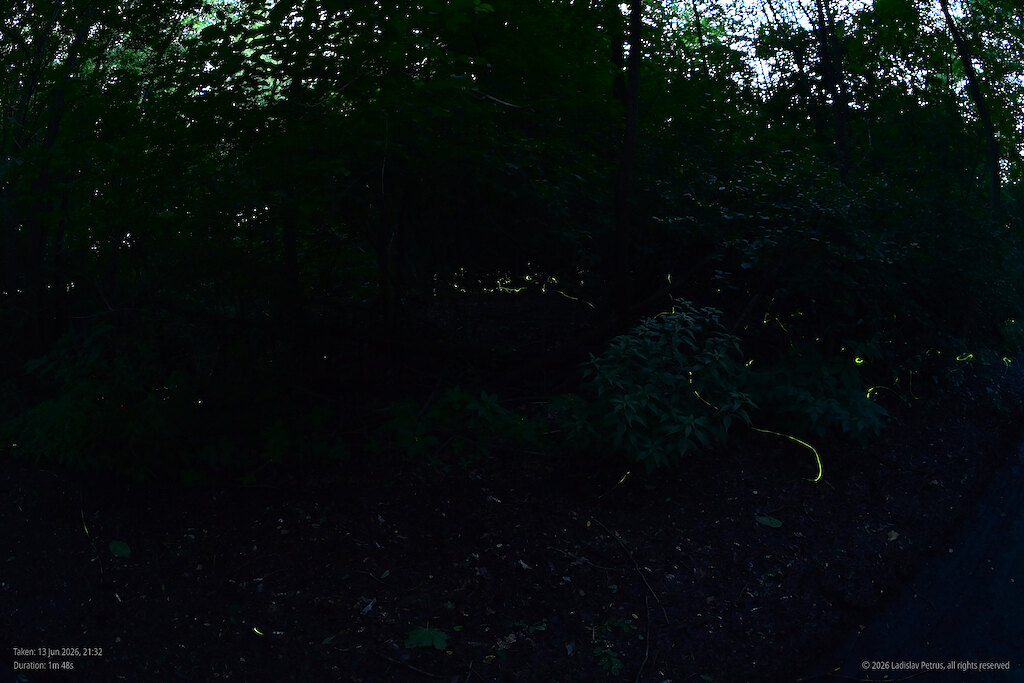
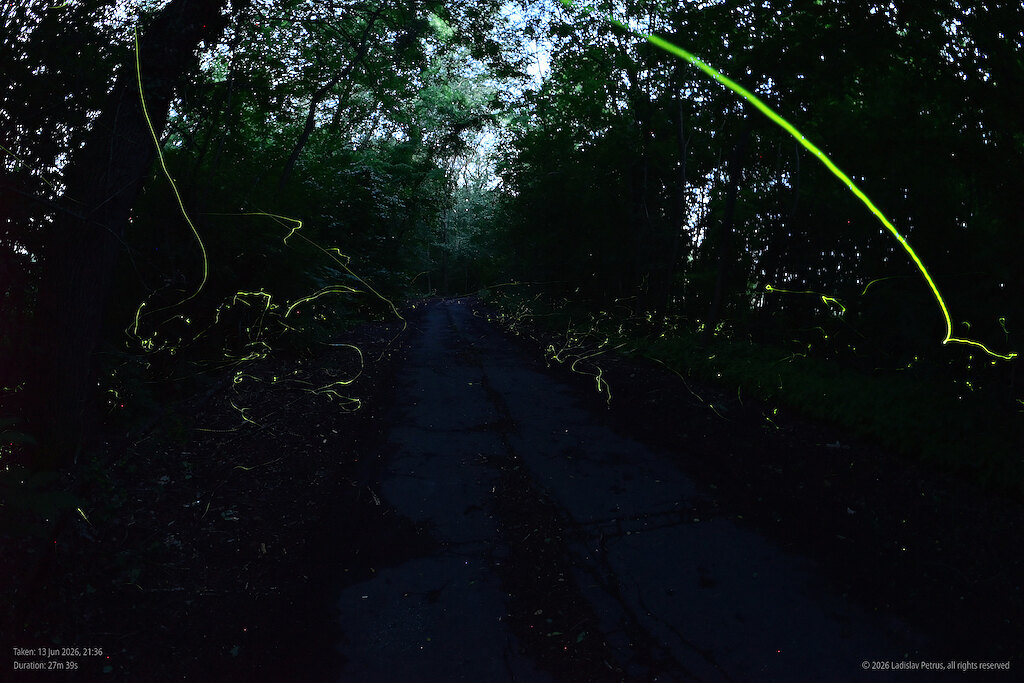
I'd been looking in the first location for a while already, but always only after 24th of June - and that was a mistake. This year I discovered that at this location they start appearing around 4th of June, likely peak around 13th of June, and by 24th of June there were only a few individuals left along the whole route. Each evening they glowed between 21:25 and roughly 22:00, with weaker activity continuing until 22:30.
I found the second, far more numerous population by chance - I was spending a few days in Smolenice. I'd read online that in the Little Carpathians the fireflies don't live up to their Slovak name - svätojánske mušky, literally "St. John's bugs", after St. John's Day (24th of June) - and appear rather later. I probably caught them at their peak, on 28th and 29th of June; on 30th of June I went to shoot once more and it felt like there were fewer than on the previous days. Here they glowed between 21:20 and roughly 22:15, with weaker activity also continuing until 22:30.
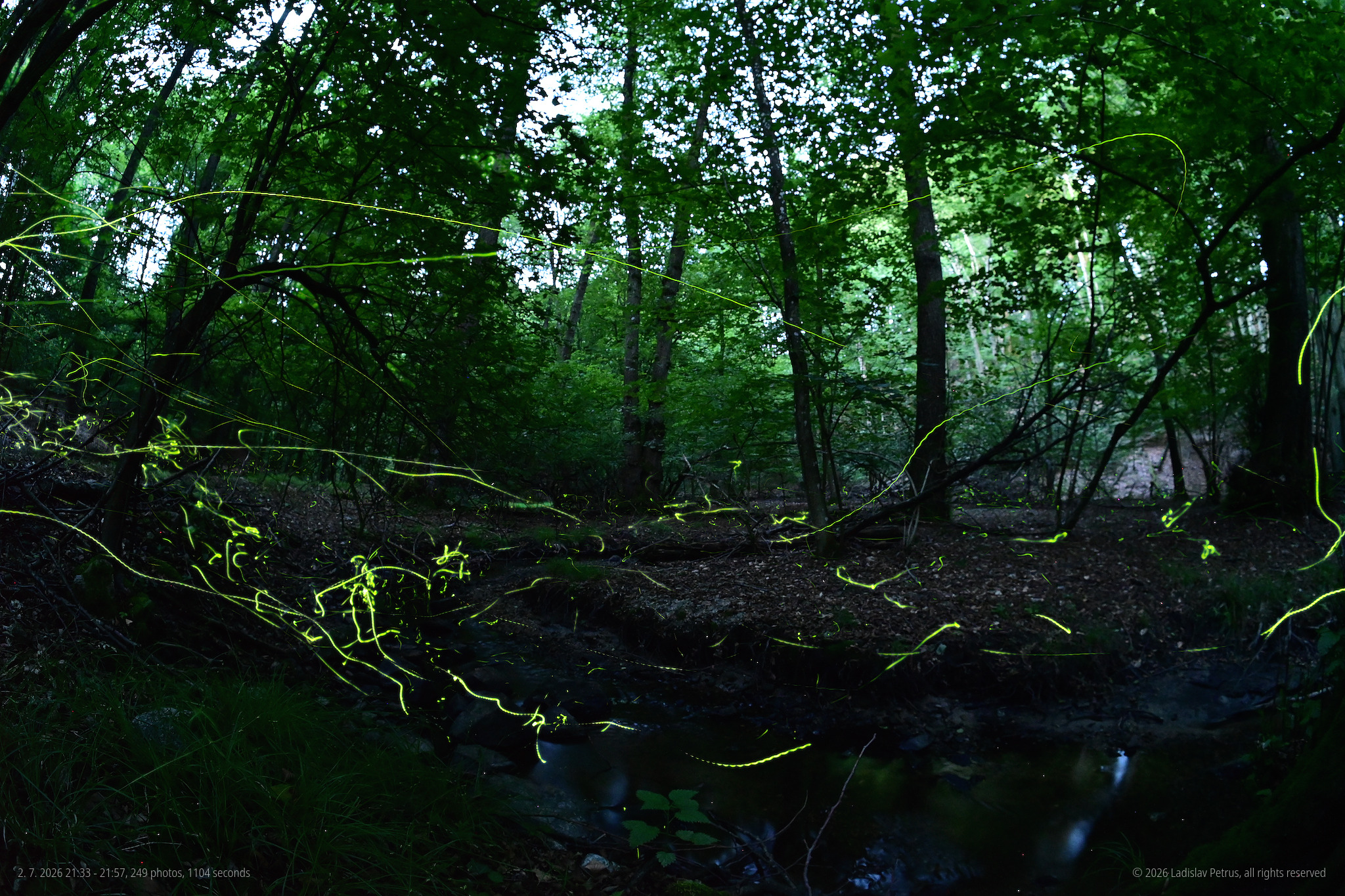
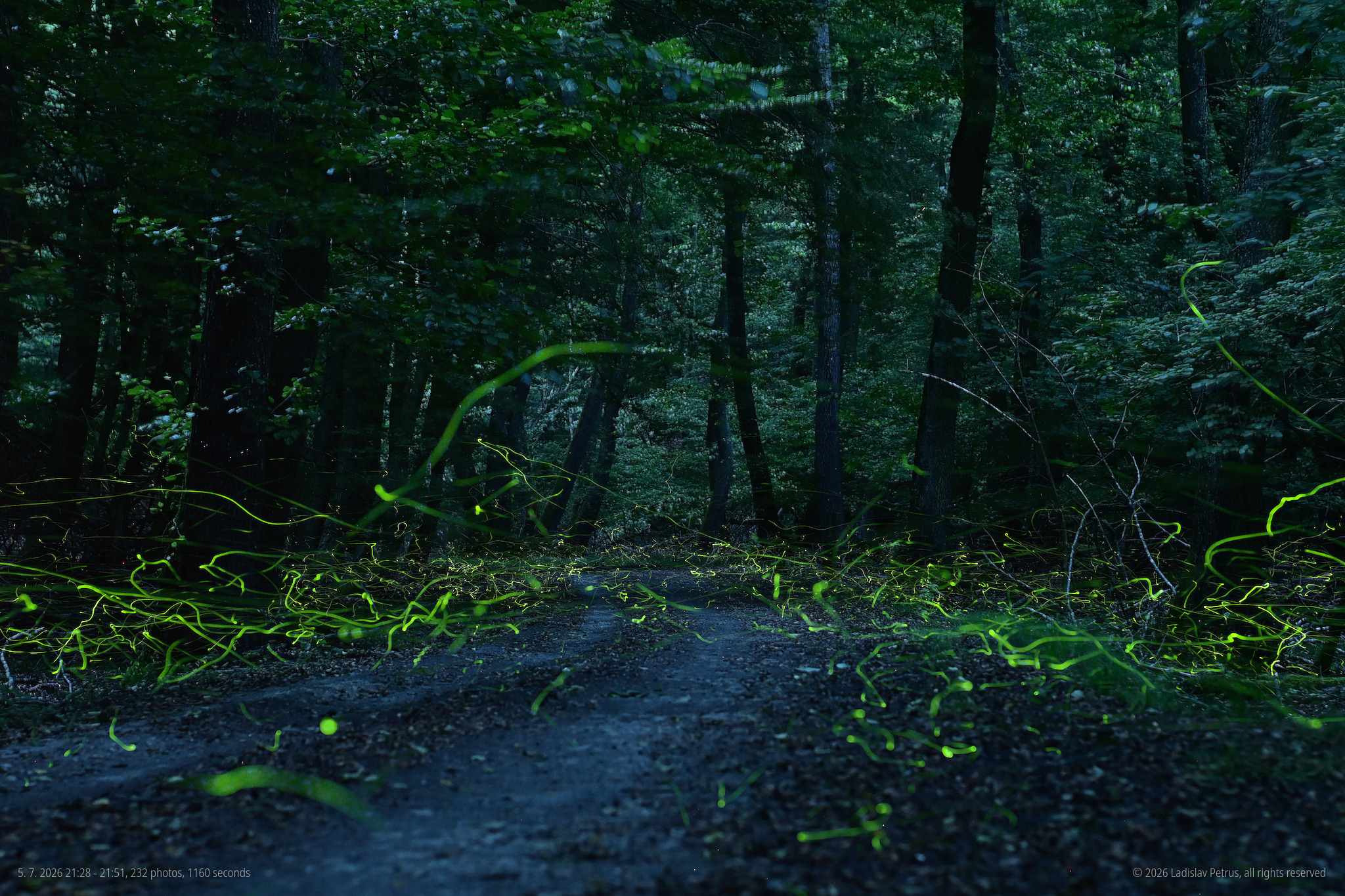
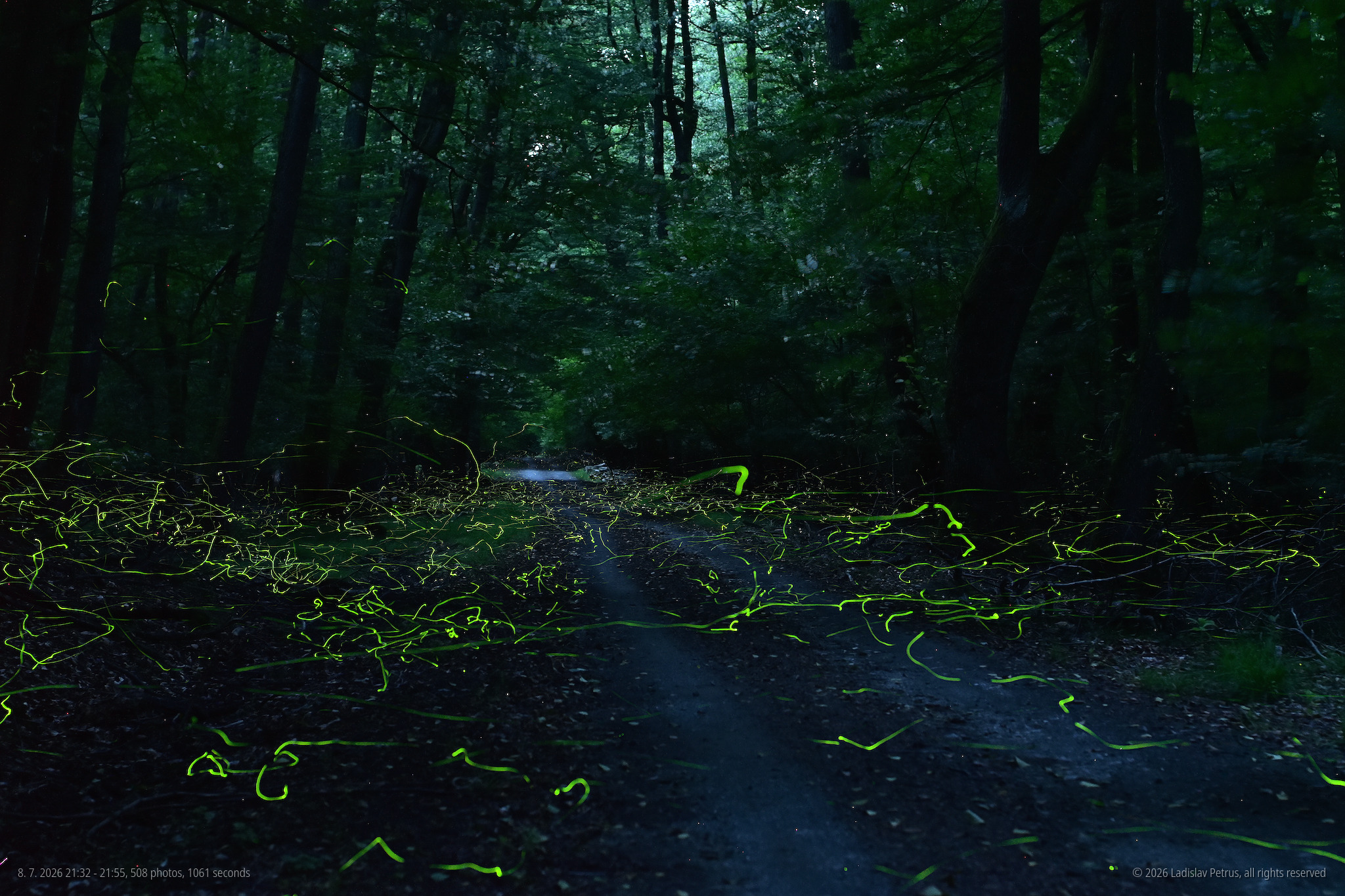
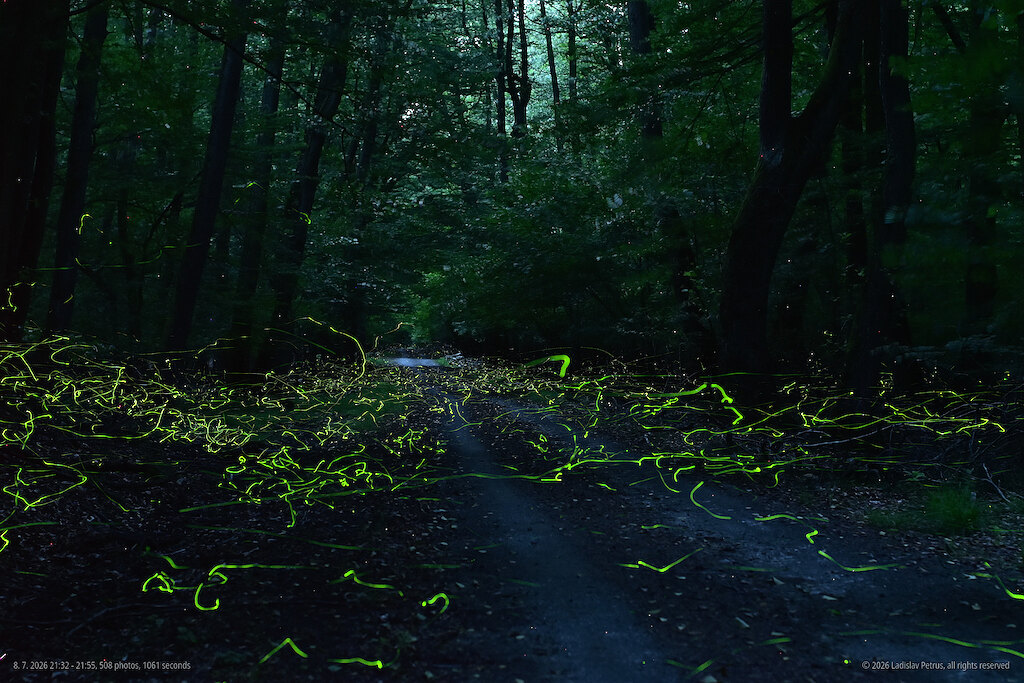
I found the third population, also very numerous, from information I'd read online. I went to shoot on the 2nd of July; here too the fireflies started glowing at around 21:20 and activity continued until at least 22:15. They were probably at their peak during my visit as well - within sight of the spot where I shot, dozens of flying individuals were glowing at once. Three days later, on the 5th of July, I returned to the same spot - again there were plenty of fireflies, active from around 21:30; the forest trail beside the stream is from that visit. I came back once more on the 8th of July, wanting to try one more perspective. In the lower part of Vydrica I saw almost no fireflies any more, but at the spot where I'd shot the previous time there were still plenty. I went to shoot a little further upstream.
I'm deliberately not naming specific locations - I don't want to make them too easy to find and thus too popular. I feel that would have a negative impact on the fireflies in the future.
In this article I've tried to pull together the essentials: how to find fireflies, how to photograph them, and what to watch out for on a night hike through the forest. Selected photos also have an expandable panel with the statistics of the settings the final image was built from.
Gallery
Click any photo to enlarge - it opens full-screen and, depending on your screen resolution, loads the appropriate version (a smaller one for Full HD and below, full resolution for larger displays), and you can switch to full resolution at any time with a button.
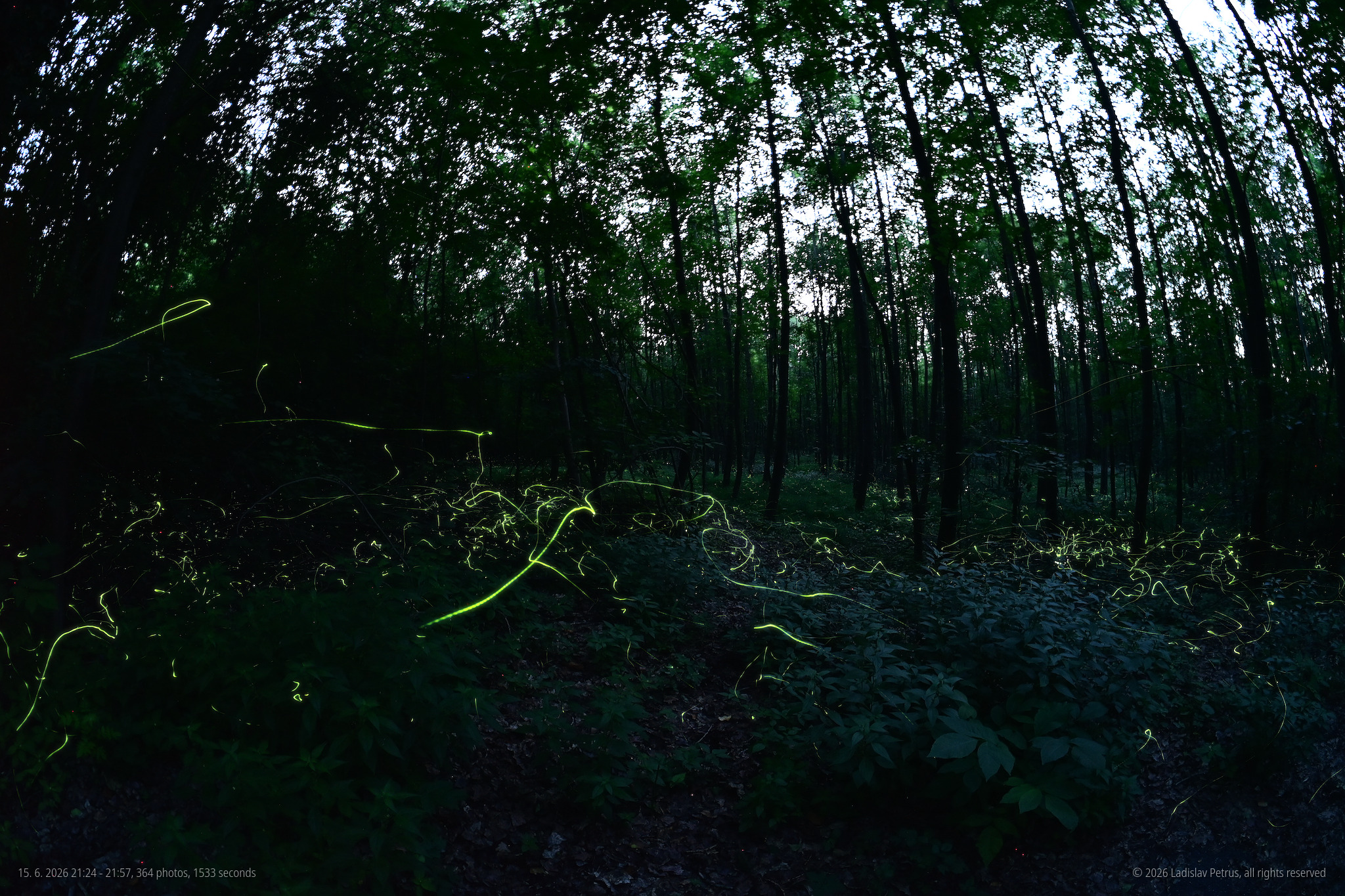
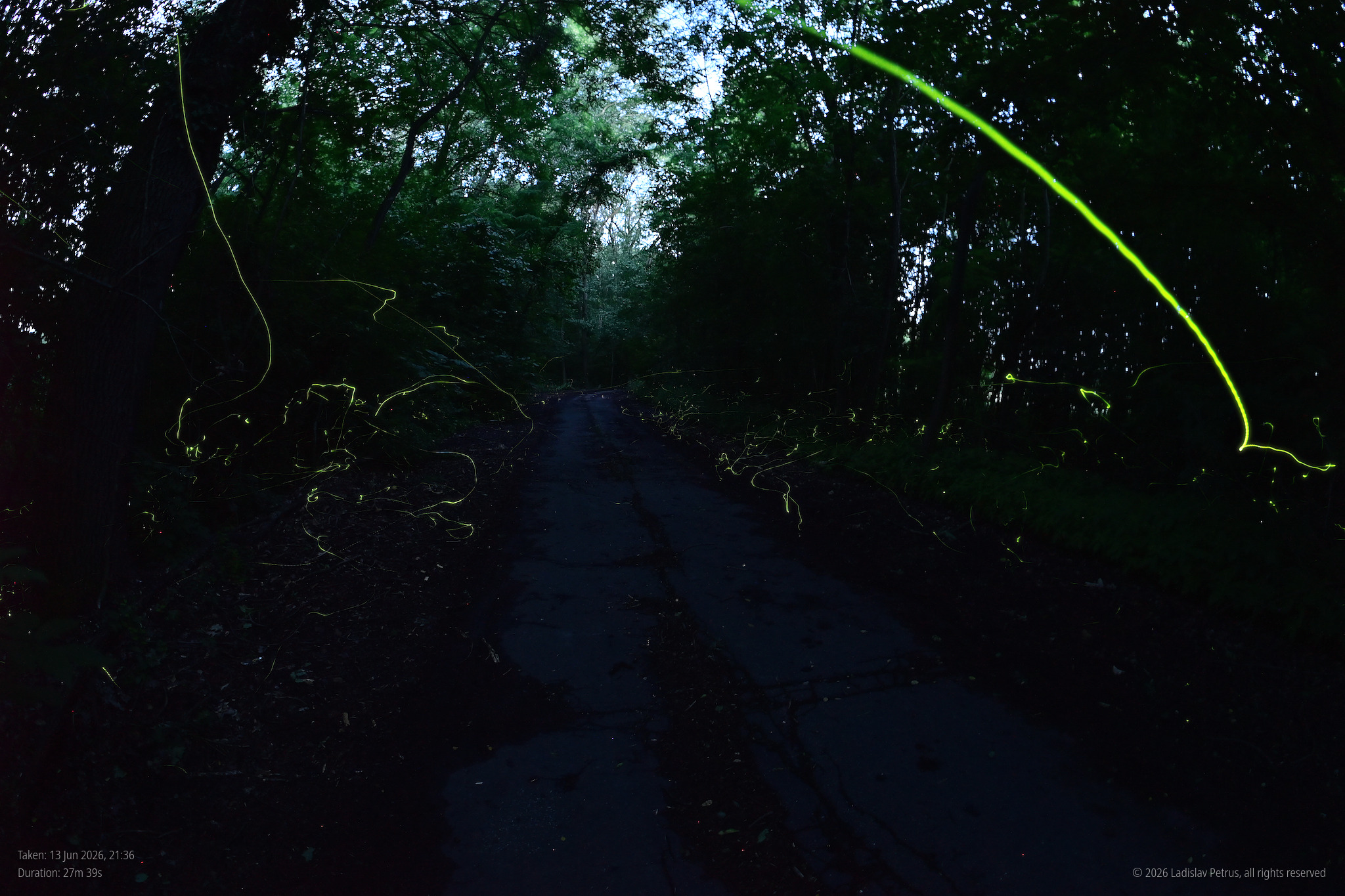
Čunovo - floodplain forest by the Danube
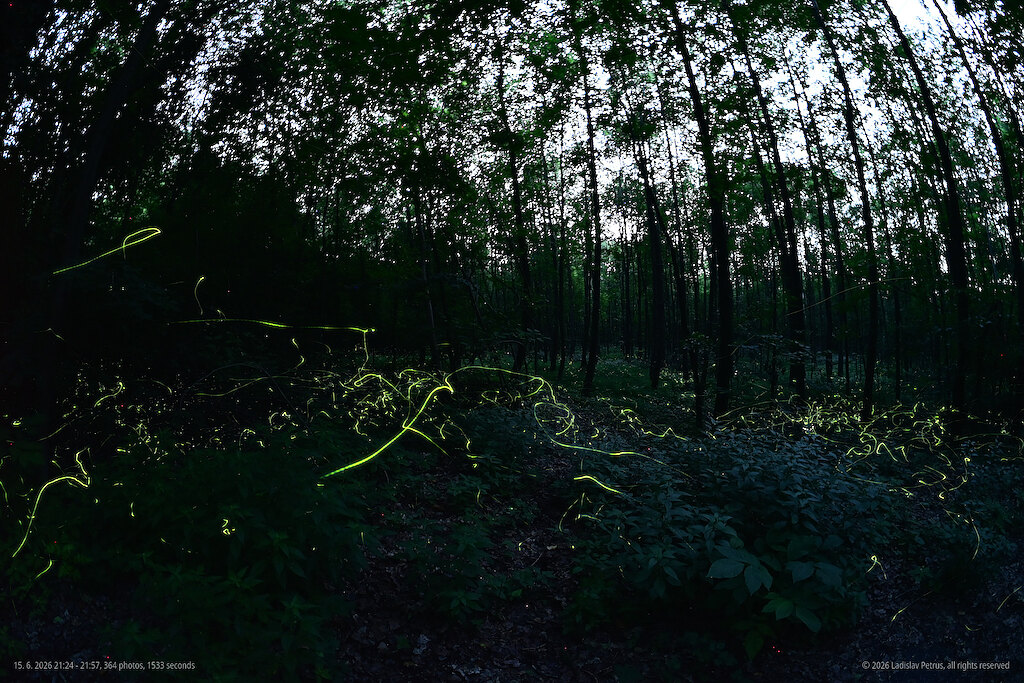
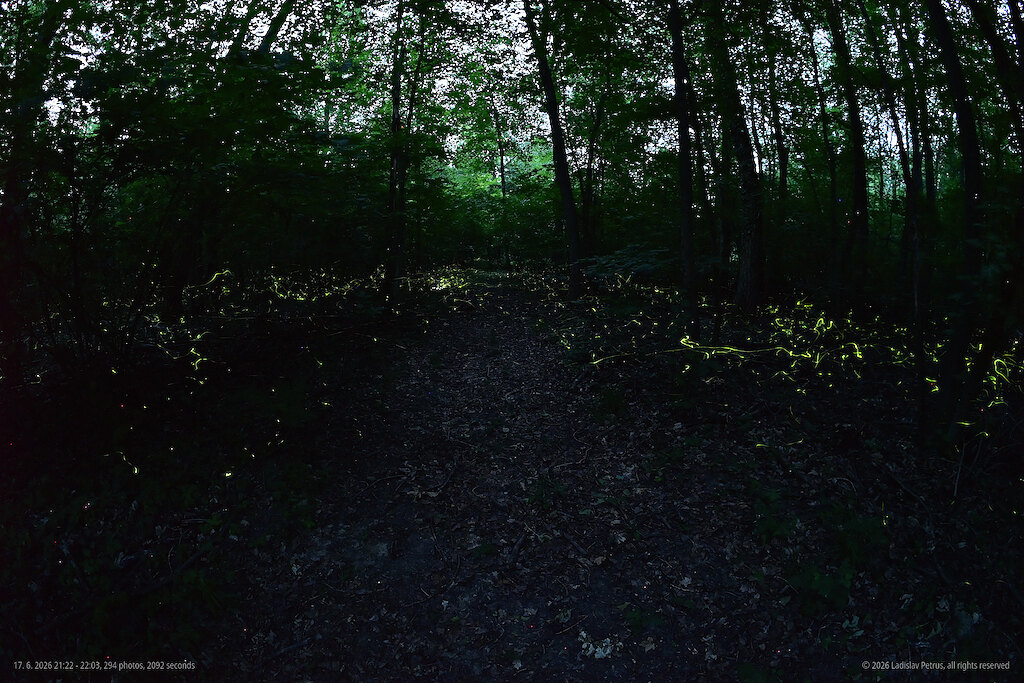
A warm, relatively humid floodplain forest between Rusovce and Čunovo, with low light pollution. Here the fireflies glow mostly low in the vegetation and among the trunks - the light stays close to the ground.
⤢ Click to enlarge
The first fireflies in the undergrowth near Čunovo - a short burst right after dark.
⤢ Click to enlarge
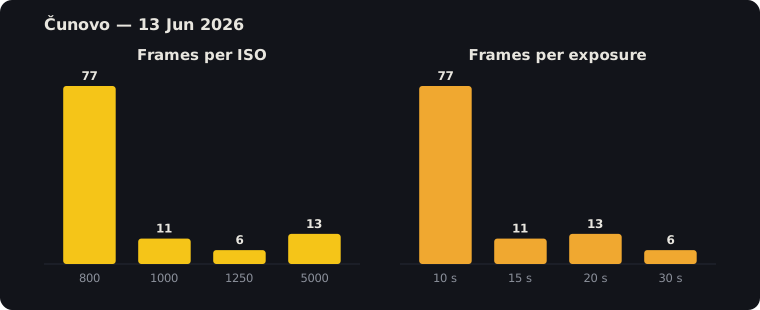
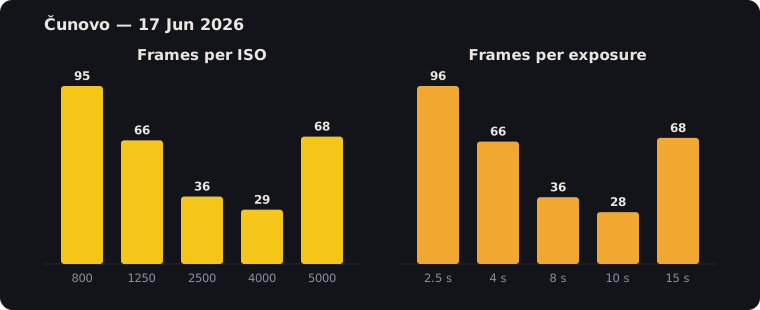
The main scene from 13th of June - nearly half an hour of frames stacked into a single image of light trails.How the photo above was made - statistics
Aperture
f/4 (fixed)
Frames
107
Time span
21:36–22:04 (27.6 min)
Total accumulated exposure
22 min 55 s
ISO (frame count)
800: 77 · 1000: 11 · 1250: 6 · 5000: 13
Exposures (frame count)
10 s: 77 · 15 s: 11 · 20 s: 13 · 30 s: 6
⤢ Click to enlarge
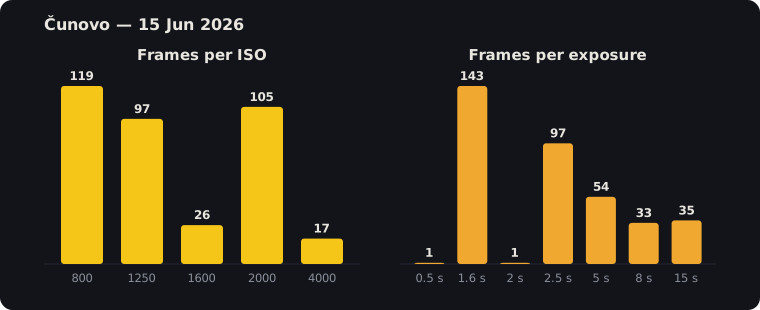
A dense swarm over a more open stretch of forest - a long sequence with settings shifting as the light faded.How the photo above was made - statistics
The last Čunovo evening of the season - fireflies in a more open part of the forest.
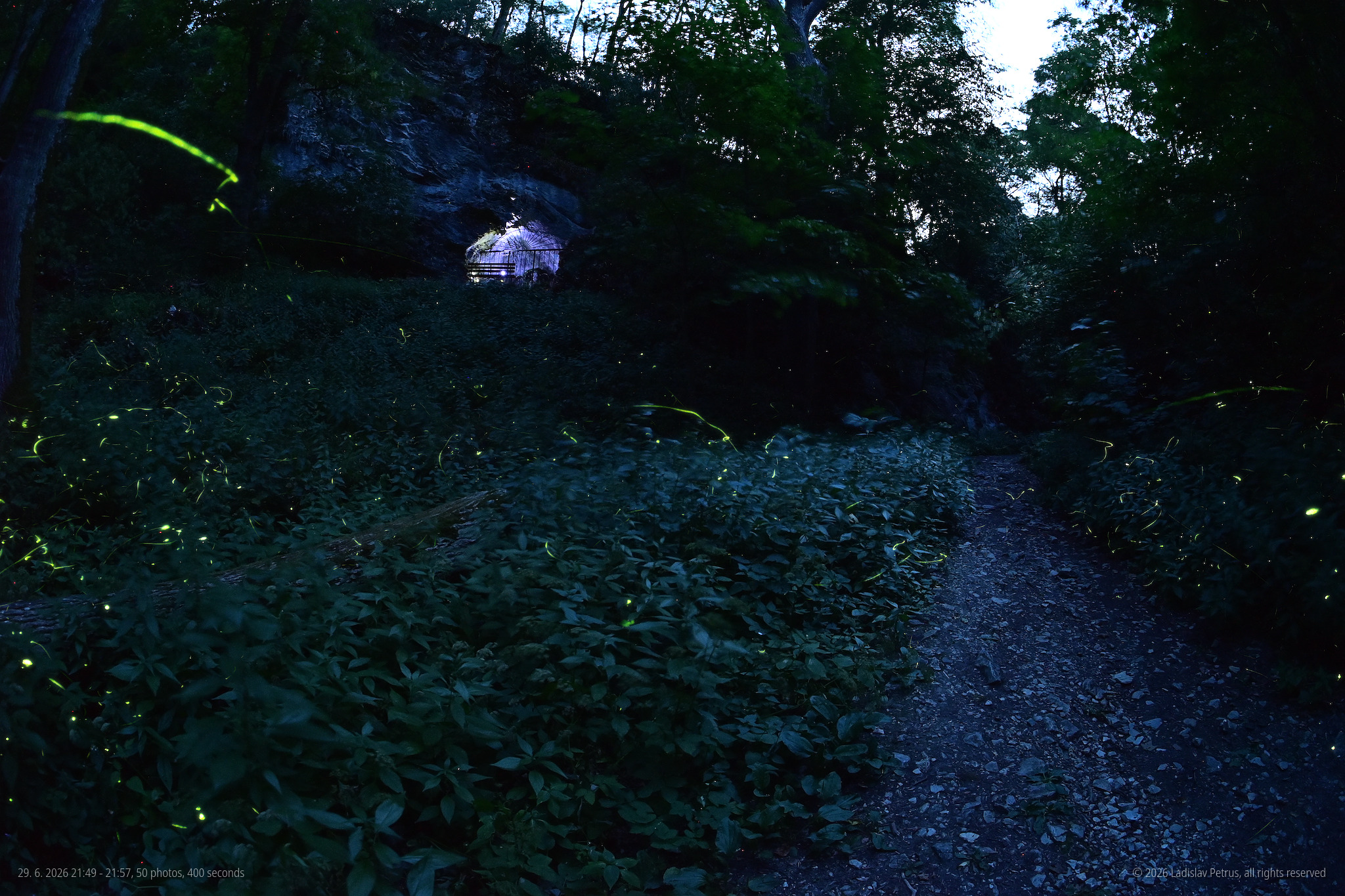
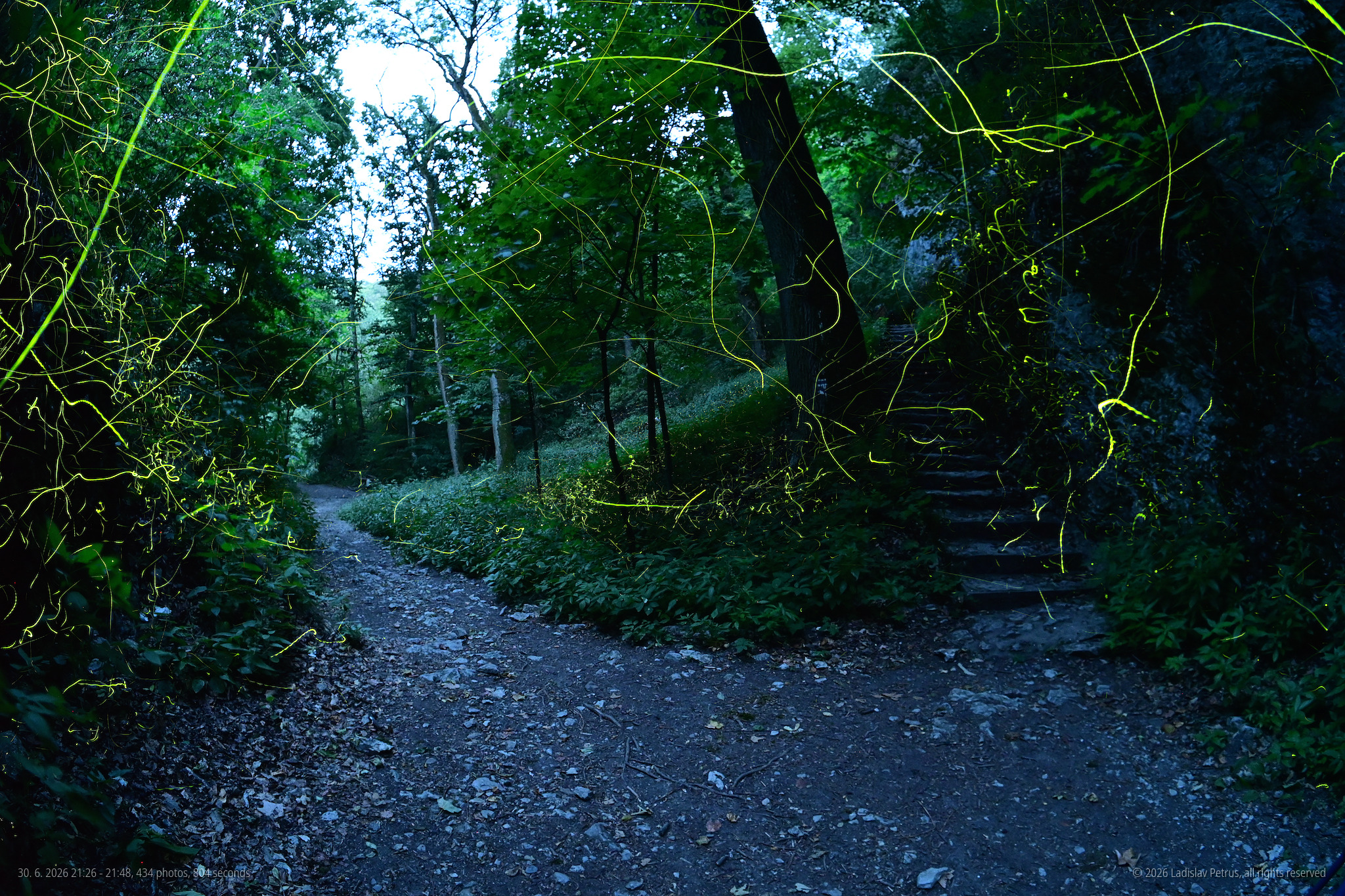
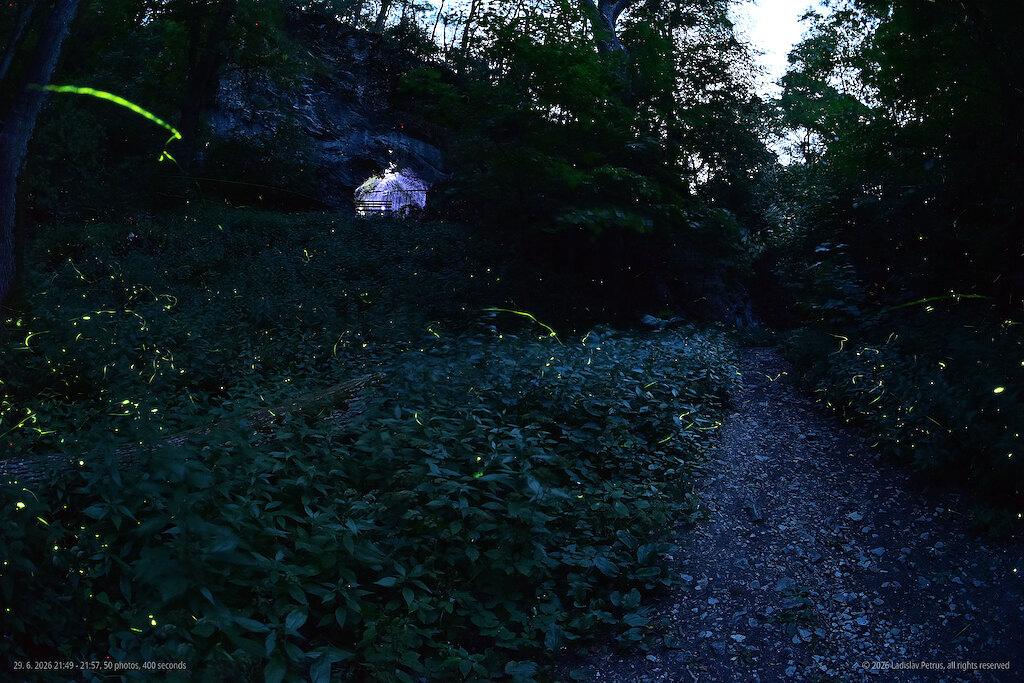
Smolenice - the Little Carpathians
A relatively moist submontane deciduous forest. Here the fireflies also climb higher up the sides of the clearing.
⤢ Click to enlarge
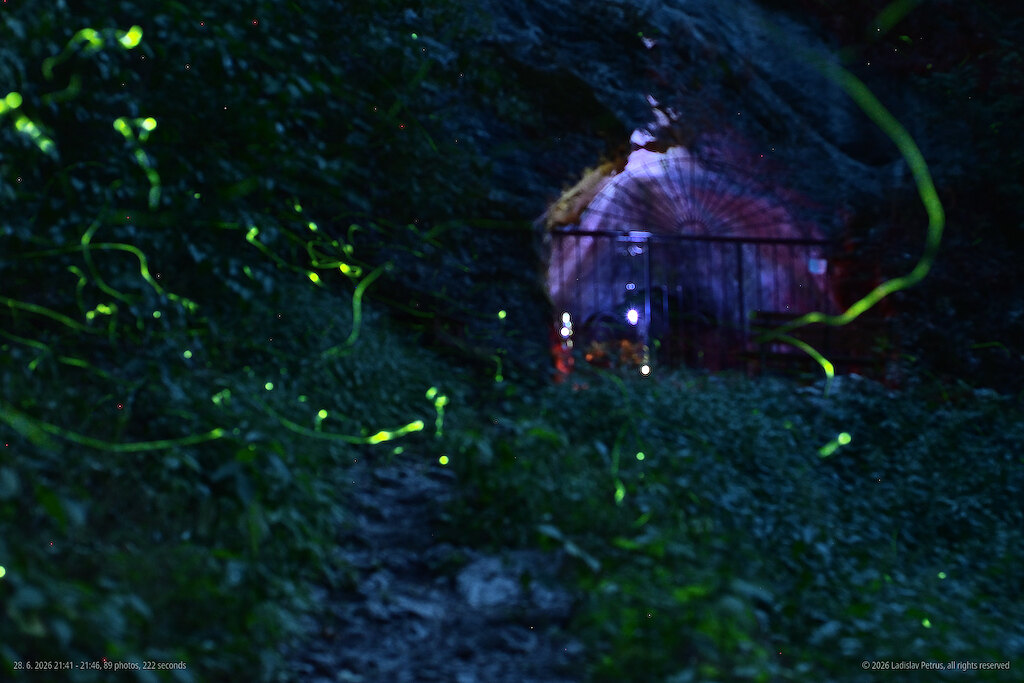
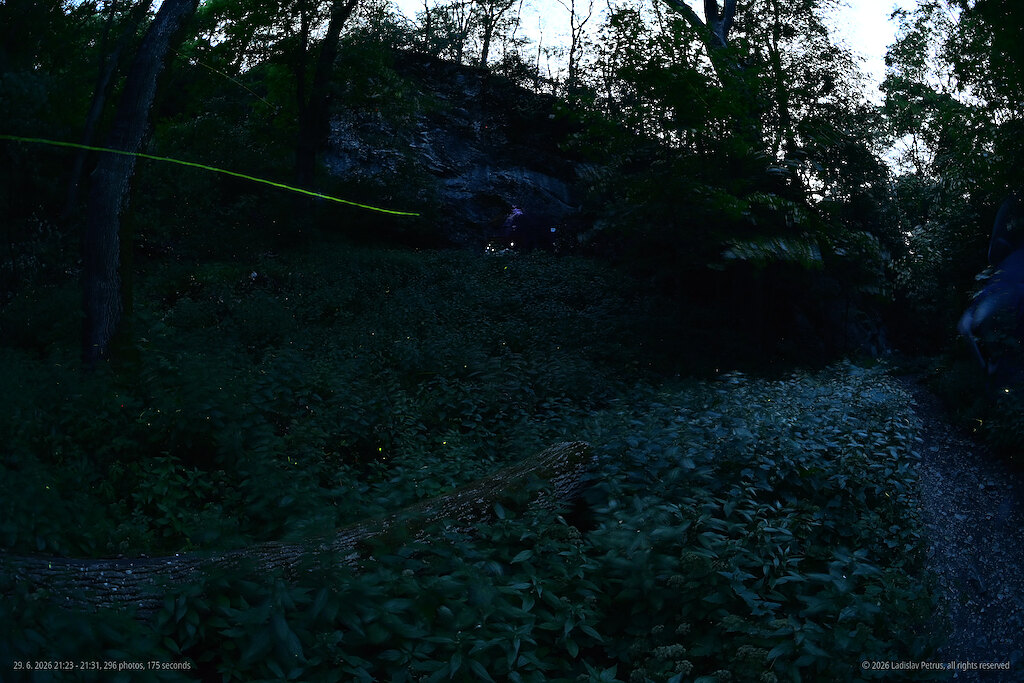
First visit to the Smolenice forest - an out-of-focus frame shot with the Nikkor 50mm f/1.4.
⤢ Click to enlarge
Dusk over the clearing - very short exposures catch the first flashes.
⤢ Click to enlarge
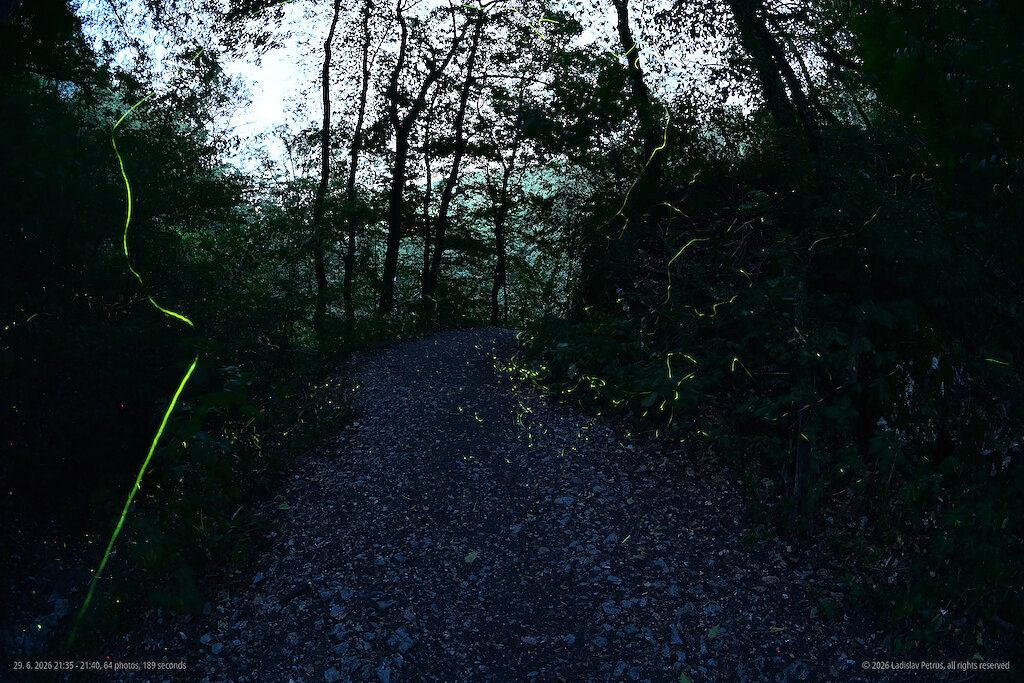
Fireflies over a forest path, early in the evening.
⤢ Click to enlarge
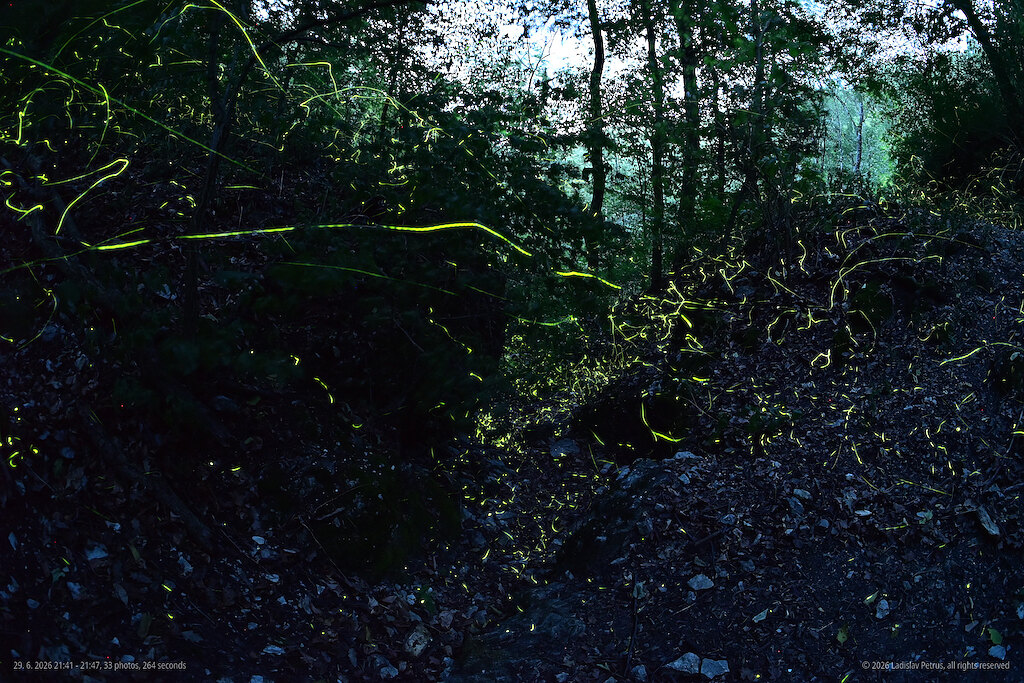
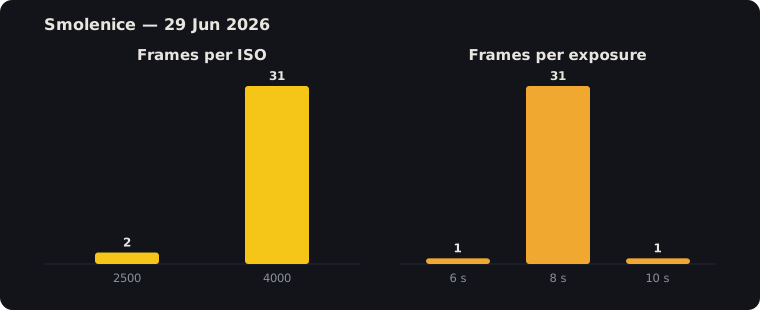
The busiest corner of the clearing - light trails in the narrow passage.How the photo above was made - statistics
Aperture
f/4 (fixed)
Frames
33
Time span
21:41–21:47 (5.5 min)
Total accumulated exposure
4 min 24 s
ISO (frame count)
2500: 2 · 4000: 31
Exposures (frame count)
6 s: 1 · 8 s: 31 · 10 s: 1
⤢ Click to enlarge
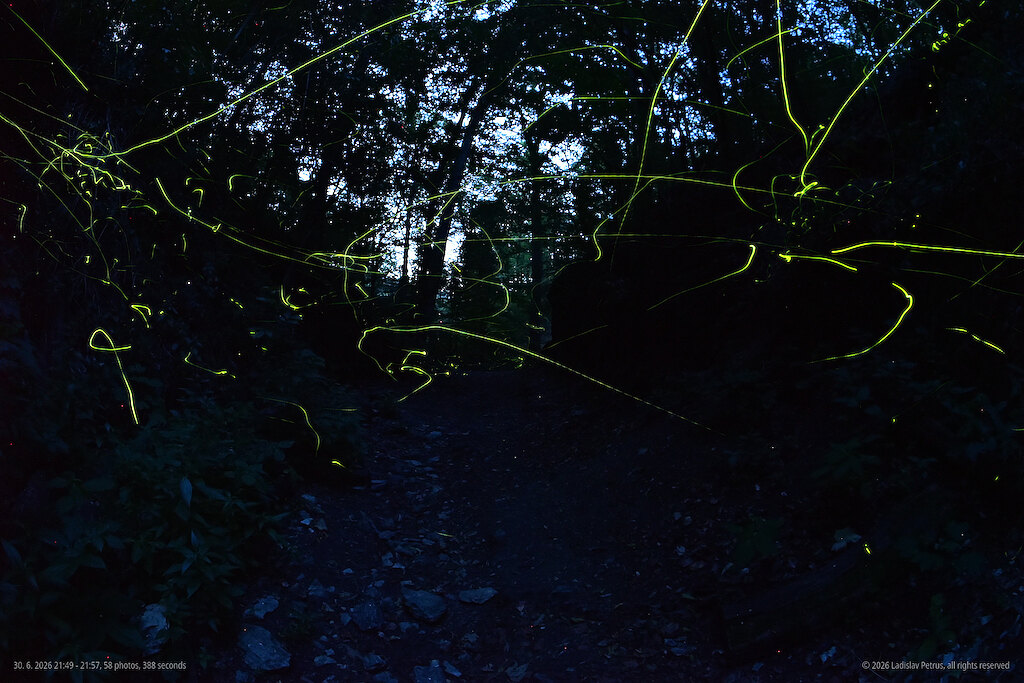
An open space - uniform long exposures draw calm, steady trails.
⤢ Click to enlarge
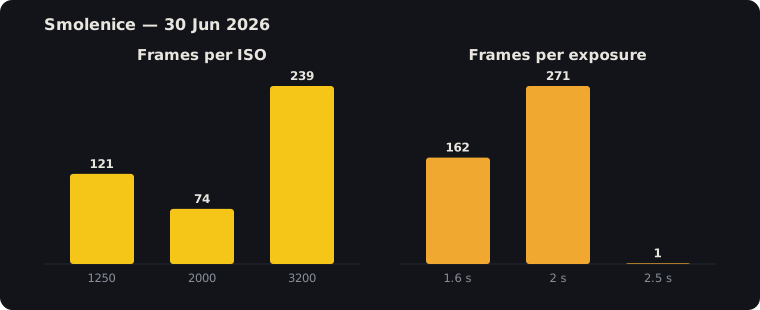
Another view of the clearing - the richest Smolenice image of the season.How the photo above was made - statistics
Aperture
f/4 (fixed)
Frames
434
Time span
21:26–21:48 (22.8 min)
Total accumulated exposure
13 min 24 s
ISO (frame count)
1250: 121 · 2000: 74 · 3200: 239
Exposures (frame count)
1.6 s: 162 · 2 s: 271 · 2.5 s: 1
⤢ Click to enlarge
The last June night in Smolenice - fireflies along the sides of the narrow passage.
Vydrica - the Little Carpathians above Bratislava
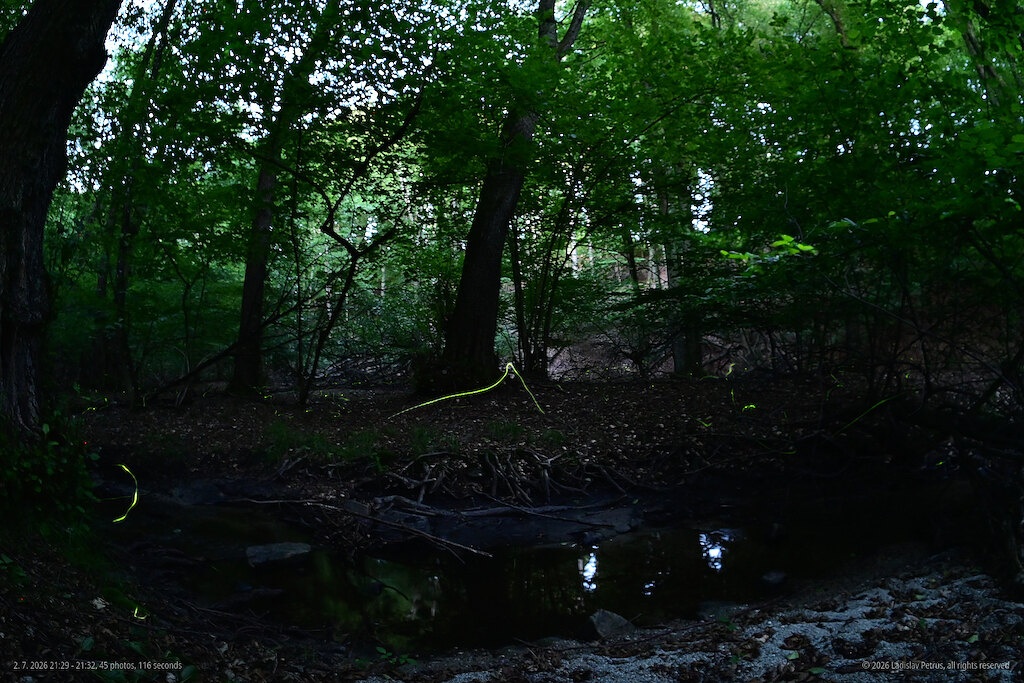
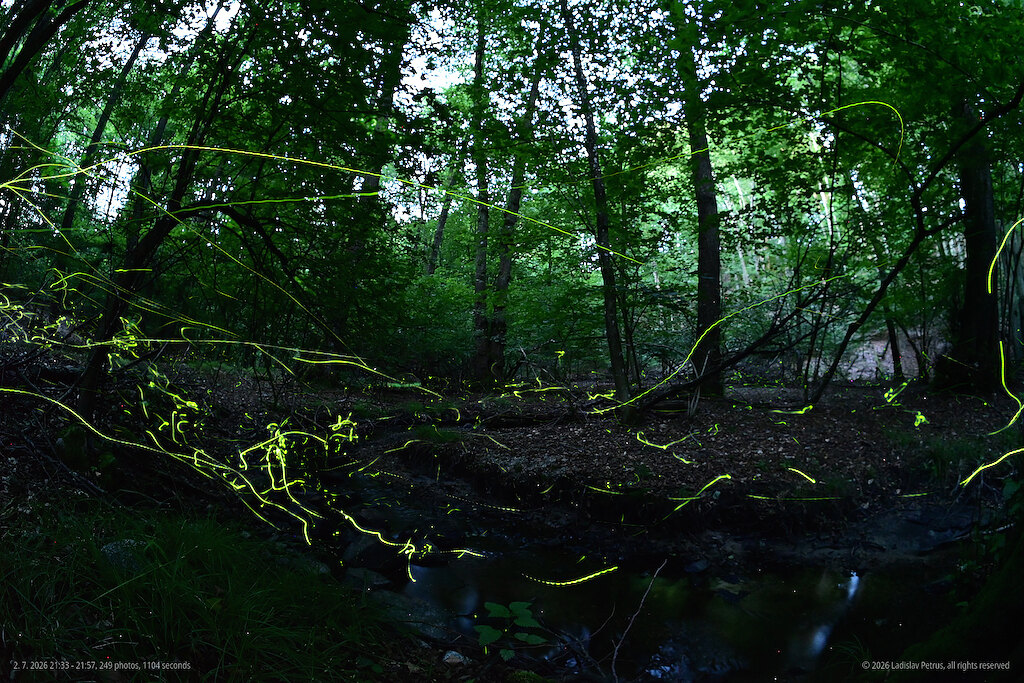
A hill-valley forest along the Vydrica stream in the Little Carpathians, with no night lighting at all. Here the fireflies glowed low over the water and along the banks of the stream.
⤢ Click to enlarge
Dusk over the stream - the first flashes while it is still light.
⤢ Click to enlarge
The Vydrica stream - the busiest evening, fireflies low over the water and its banks.How the photo above was made - statistics
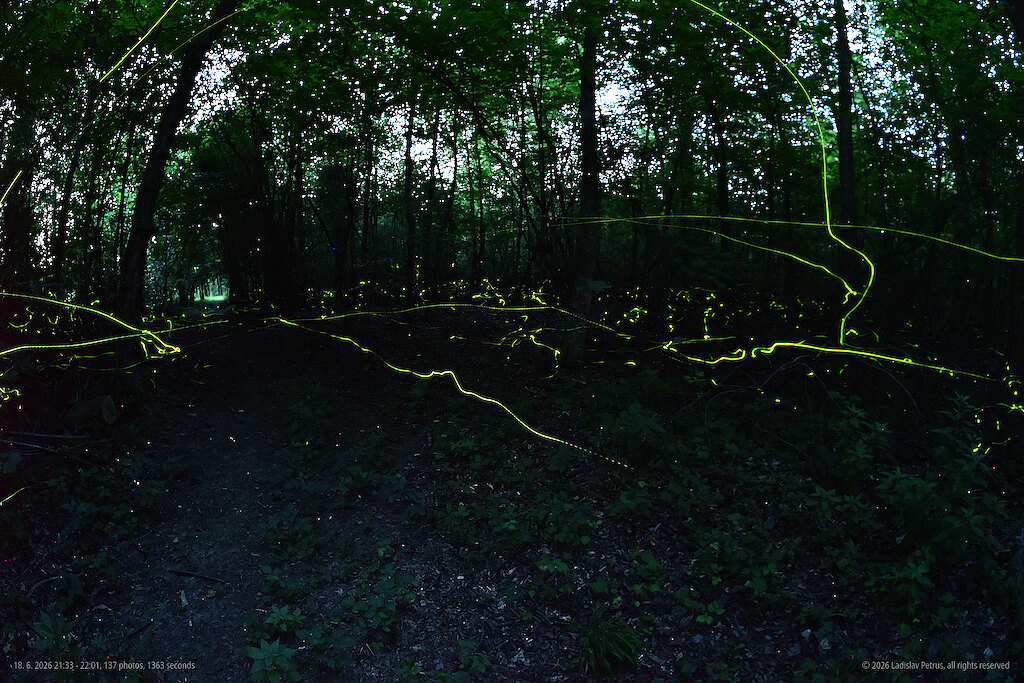
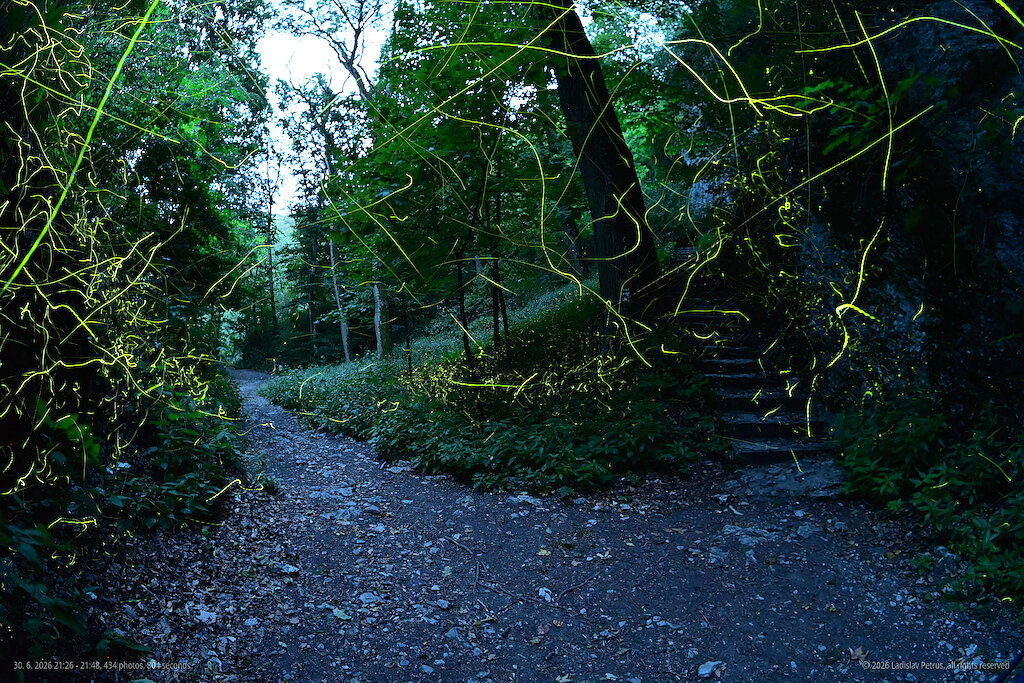
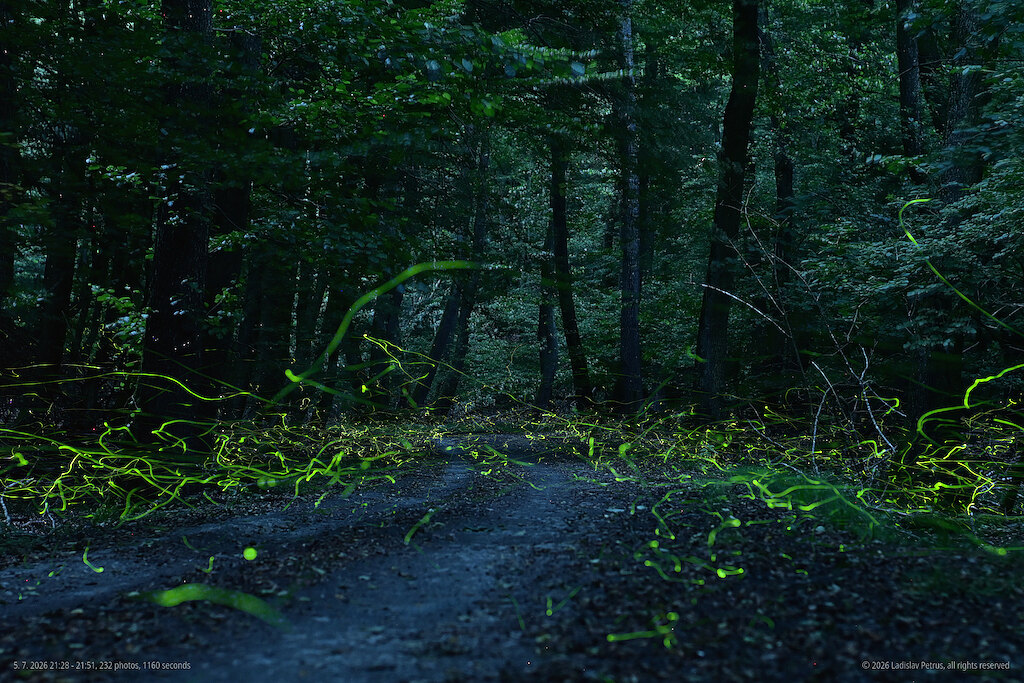
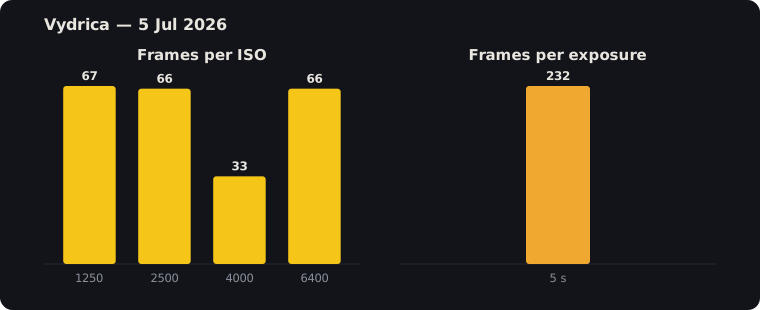
A forest trail by the Vydrica stream three days later - fireflies over the trail.How the photo above was made - statistics
Aperture
f/4 (fixed)
Frames
232
Time span
21:28–21:51 (23.1 min)
Total accumulated exposure
19 min 20 s
ISO (frame count)
1250: 67 · 2500: 66 · 4000: 33 · 6400: 66
Exposures (frame count)
5 s: 232
⤢ Click to enlarge
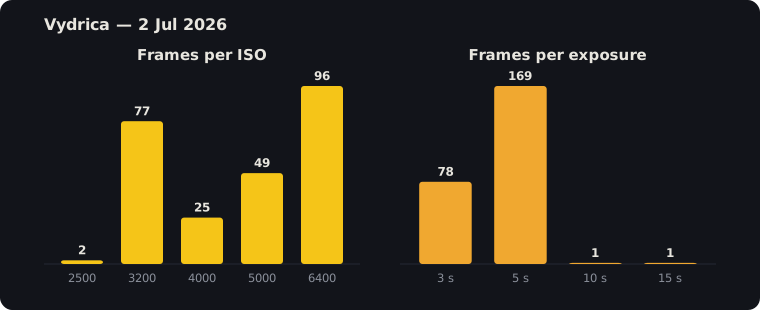
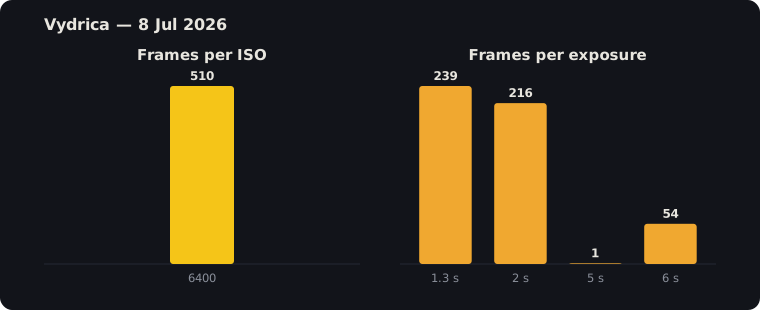
A frame from the 8th of July - higher up the trail near Vydrica, where the fireflies were still numerous.How the photo above was made - statistics
Aperture
f/4 (fixed)
Frames
510
Time span
21:31–21:55 (23.6 min)
Total accumulated exposure
17 min 52 s
ISO (frame count)
6400: 510
Exposures (frame count)
1.3 s: 239 · 2 s: 216 · 5 s: 1 · 6 s: 54
Fireflies in motion
The stills above are a sum of a whole series - every light trail at once. But the same frames can also be set in motion: each trail lights up briefly at the moment it actually appeared, then fades again. Nothing accumulates - a moving window of "recent" fireflies flows across the scene, loops seamlessly, and comes closer to how it really looked out in the forest. Click any preview to play a short loop.
A dense swarm over a more open stretch of forest - a long sequence with settings shifting as the light faded.
The main scene from 13th of June - nearly half an hour of frames stacked into a single image of light trails.
An open space - uniform long exposures draw calm, steady trails.
Another view of the clearing - the richest Smolenice image of the season.
The Vydrica stream - the busiest evening, fireflies low over the water and its banks.
A forest trail by the Vydrica stream three days later - fireflies over the trail.
A frame from the 8th of July - higher up the trail near Vydrica, where the fireflies were still numerous.
How activity waned through the evening
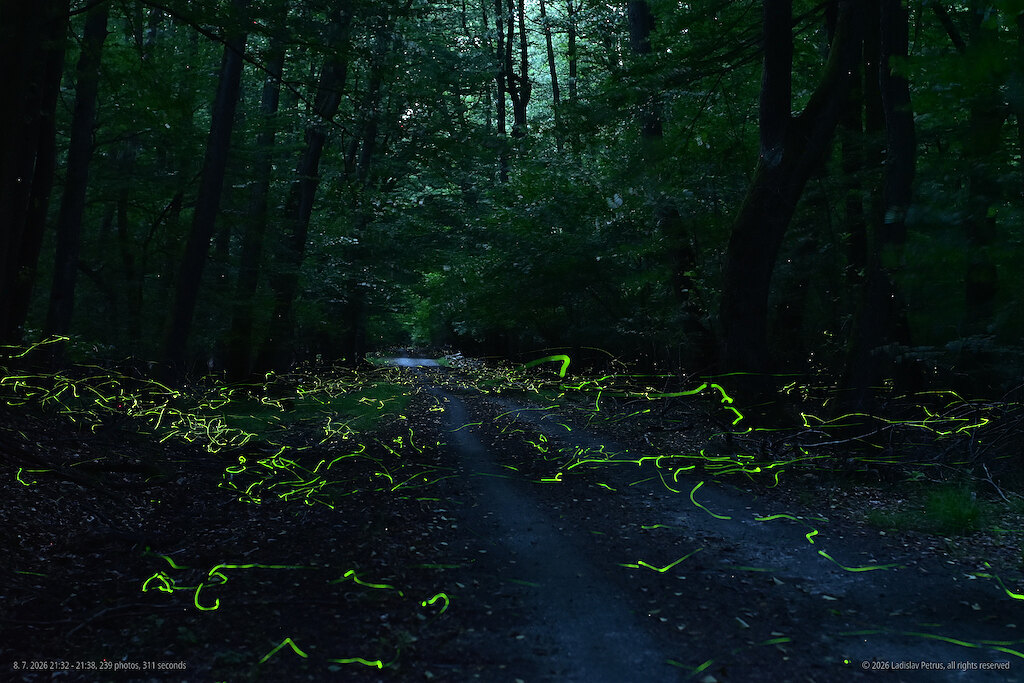
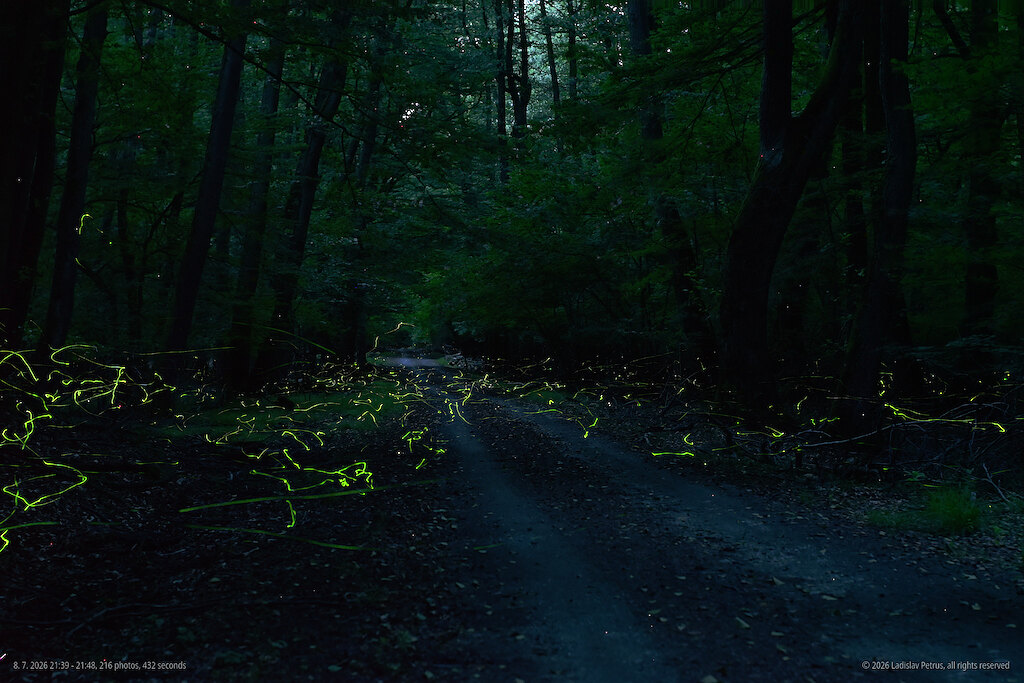
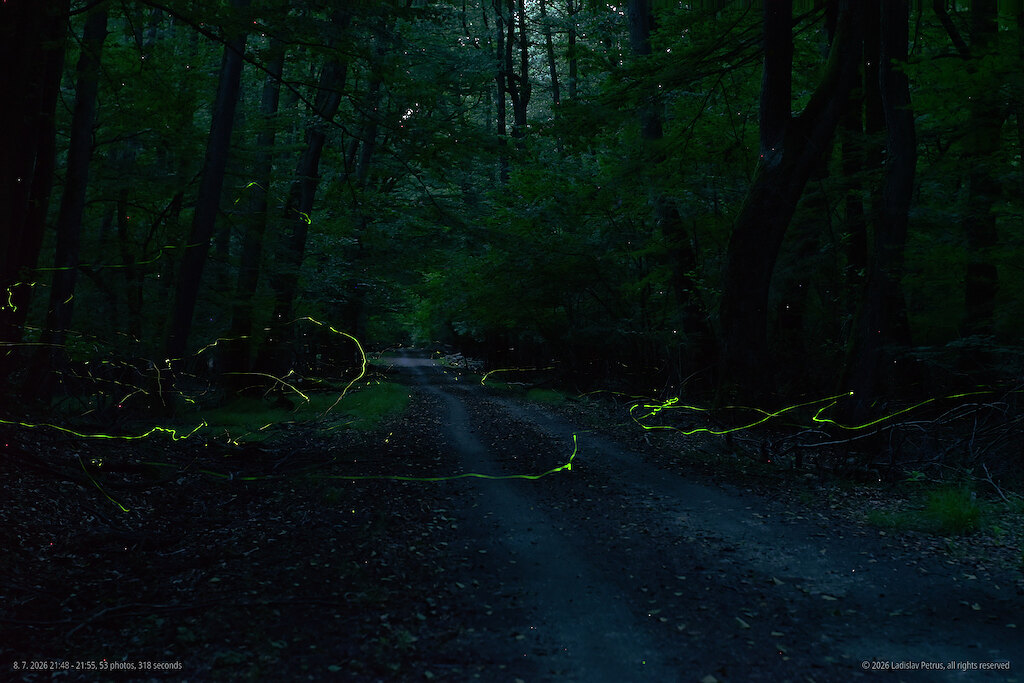
The frames from the 8th of July show nicely how firefly activity shifts over the course of a single evening. Higher up the trail near Vydrica it was still strong - though weaker than on my previous visit. I split the series from that evening into three time intervals: the most fireflies flew right after dark, and there were noticeably fewer in each of the next two.
⤢ Click to enlarge
21:32–21:39 - right after dark, the strongest activity (239 frames, 1.3 s).
21:49–21:55 - only the last, fading flashes (53 frames, 6 s).
Where and when to look for fireflies
A few observations and theory about where they occur:
Fireflies occur near water - even intermittent water. What matters is that the spot is cooler and damper than its surroundings.
They like darkness. Don't look for them near street lighting or unnaturally lit places. This is also where observation etiquette comes in - minimise the use of headlamps, flashes and artificial light; if you must use a light, use only red light, and as little of it as possible.
They like undisturbed vegetation - places with low bushes where leaf litter stays on the ground over winter and decomposes naturally. The larvae feed on snails, which thrive in such an environment.
They like warm nights (20+ °C), but surprisingly they don't mind flying even at 14 °C - they just glow for a shorter time that night.
From my observations, they start appearing about 30 minutes after sunset, and the peak lasts roughly 45 minutes.
They start glowing in the bushes and the darker parts of the forest, and as it gets darker they venture out into the more open areas too.
They also occur in meadows next to forests, but so far I haven't seen them there in numbers worth photographing.
How to photograph fireflies
My goal was to capture the fireflies' light trails, so I tailored my whole shooting strategy to that. None of the photos on this page is a single exposure - each was made by stacking a series of dozens to hundreds of frames. What I recommend:
A manual lens with a hyperfocal scale. I shot all the good frames with a manual TTArtisan APS-C 7.5 mm F2 Fisheye. Its advantage is that the focus ring has the hyperfocal ranges marked for individual apertures.
Aperture f/4. At f/4 the hyperfocal scale gave me focus from 0.3 m to infinity, so I didn't have to deal with focusing during the evening at all.
A Nikon Z fc body. The key is being able to fire a long series of frames back-to-back - with the built-in intervalometer, a remote release, or at least continuous shooting.
I also tried a Nikkor 50 mm f/1.4, but its hyperfocal ranges aren't clearly marked and its focus indicator is very hard to read. Next season I want to try manual TTArtisan 25 mm and 50 mm lenses - a wide view is great, but individual firefly trails are quickly lost with distance; at longer focal lengths you can achieve other interesting effects.
ISO from 800 upward. I started at ISO 800 and gradually raised it up to 6400. Fireflies can apparently regulate the intensity of their light, and as it gets darker they glow more faintly. Higher ISO adds noise, which can be partly suppressed via stacking.
Exposure length. I chose it so that the background and vegetation were on the edge of visibility and the scene looked like an evening forest - in practice from ~0.5 s at dusk to 20–30 s in full darkness. Shorter times give dotted, "sparkly" trails; longer ones give continuous streaks.
Choose your composition early and stay put for at least 5 minutes. Firefly activity is quite "statistical" - they often fly beautifully while I'm framing the shot, disappear once I start the series, and come back a few minutes later. But you also have to account for their shift into the lighter parts of the forest as darkness sets in.
A tripod is a must. All the published photos were made as a combination of a series of frames, so the shots have to align pixel-for-pixel. When composing, it's also worth thinking about flight levels: fireflies start flying low over the vegetation, dare higher as it gets darker, and also like to follow the walls (edges) of the vegetation.
I stack straight from the camera's JPEGs - with hundreds of frames it's practical and the result is excellent.
Night hike through the forest: what to watch out for
Photographing fireflies means being alone in the forest after dark. It shouldn't be underestimated:
Disorientation / terrain - In the dark, even a familiar forest changes and you can easily lose your bearings, especially off the trail. I don't recommend going into terrain you don't know well. Roots, holes, fallen branches, streams, steep slopes - at night you simply can't see them.
Wildlife - In our forests you may genuinely meet a wild boar (especially a sow with young), a fox or a deer. Most will flee, but a close encounter isn't pleasant. That's why I recommend not walking silently - a continuous conversation is best. That way the animals learn well in advance that you're coming and leave before a problem arises.
A dead phone or batteries. No light and no map in unfamiliar terrain is a problem. Charge everything before the trip and carry several different sources of light and, if needed, navigation.
Night hike through the forest: what worked for me
Headlamp + backup torch + power bank. Two lights beat one.
Use red light. It preserves your night vision and won't scare the fireflies.
Offline map and GPS. Save your car's location and plan your route before starting to hike.
Walk the route in daylight. Knowing the terrain while it's light is priceless.
Tick protection: long trousers tucked into socks, repellent, and a thorough check when you get back.
Layer your clothing and bring a waterproof layer - it can get colder at night than you expect.
Sturdy footwear with a good tread.
Behave respectfully: don't catch the fireflies, don't shine white light needlessly, don't make noise. We're guests out there.
How the final image comes together: a brief post-processing walkthrough
As I mentioned, every shot is assembled from a whole series of frames. The workflow I refined this year looks roughly like this:
A series of frames from a tripod. Dozens to hundreds of shots of the same scene, back-to-back.
"Lighten" (maximum) stacking. For each pixel, the brightest value across the series is kept - so every flash "accumulates" into a continuous light trail.
Hot-pixel removal. Before stacking, frame by frame - otherwise noise dots would burn into the result as permanently glowing spots.
A background plate via "minimum" stacking. The opposite stack (the minimum of each pixel) yields a clean, dark scene with no fireflies - the background landscape.
Trail enhancement. Through a mask that selects only what is transient (changes between frames) and at the same time yellow-green (the fireflies' colour), I gently strengthen and make the trails glow - without lifting the sky or the foliage.
A gentle lift of the dark (gamma). I'd rather "pull" a night scene with gamma than with brightness - it looks more natural and doesn't drag out as much noise.
Export. Convert to sRGB, add a watermark, produce a 2048 px version for the web and a full-resolution one for zooming in.
Closing
Fireflies are with us for only a few weeks a year, and then the season is over. All the more reason to be out there exactly when it's "the" evening. I hope these notes help you find your own spot and capture your own light trails - and above all, enjoy that quiet summer forest. Stay safe, be respectful, and leave the fireflies glowing for others too.
Contact
If you have questions, thoughts, or want to swap tips on photographing fireflies, drop me a line at ladislav.petrus@rt.sk.
 ⤢ Click to enlarge
 ⤢ Click to enlarge
 ⤢ Click to enlarge
 ⤢ Click to enlarge
 ⤢ Click to enlarge
 ⤢ Click to enlarge
 ⤢ Click to enlarge
 ⤢ Click to enlarge
 ⤢ Click to enlarge
 ⤢ Click to enlarge
 ⤢ Click to enlarge
 ⤢ Click to enlarge
 ⤢ Click to enlarge
 ⤢ Click to enlarge
 ⤢ Click to enlarge
 ⤢ Click to enlarge
 ⤢ Click to enlarge
 ⤢ Click to enlarge
 ⤢ Click to enlarge